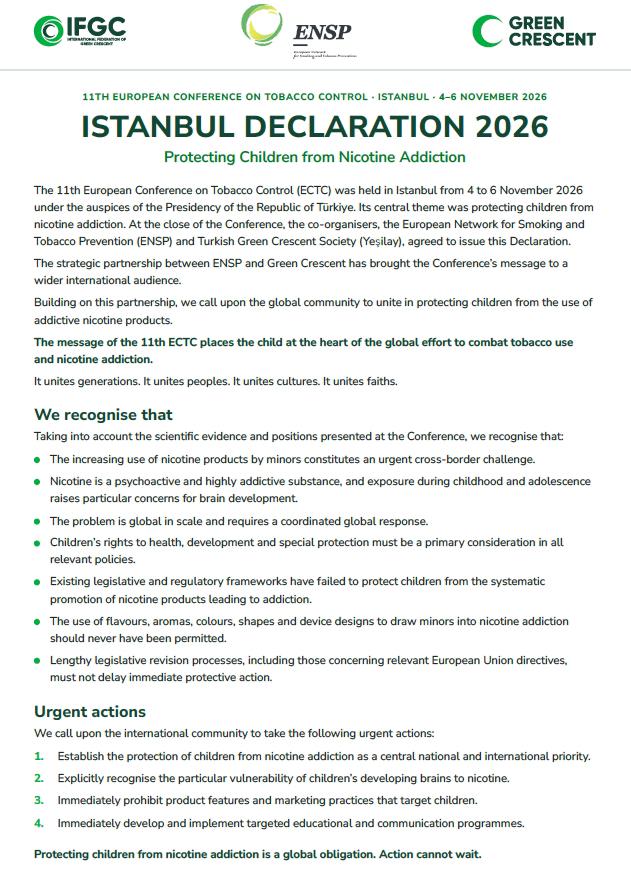
The message of ENSP is reinforced by the Istanbul Declaration 2026 – Protecting Children from Nicotine Addiction, adopted by ENSP and the Turkish Green Crescent Society (Yeşilay) at the conclusion of the 11th European Conference on Tobacco Control, held in Istanbul from 4 to 6 November 2026.
The Declaration calls upon the international community to unite in protecting children from addictive nicotine products. It recognises that the increasing use of nicotine products by minors is an urgent cross-border challenge, that nicotine exposure during childhood and adolescence raises particular concerns for brain development, and that existing legislative and regulatory frameworks have not adequately protected children from the promotion of addictive products.
It sets out four urgent priorities for action:
- Establish the protection of children from nicotine addiction as a central national and international priority.
- Explicitly recognise the particular vulnerability of children's developing brains to nicotine.
- Immediately prohibit product features and marketing practices that target children.
- Immediately develop and implement targeted educational and communication programmes.
The Declaration also sends a clear message to policymakers: lengthy legislative revision processes must not delay immediate protective action.
For ENSP, these commitments should guide both European and national policy decisions. The protection of children from nicotine addiction must be placed at the centre of tobacco control strategies, legislative reforms and international cooperation.
Defending the Tobacco-Free Generation 2040 objective
ENSP calls for the explicit preservation of the objective of achieving a Tobacco-Free Generation by 2040 and for a prompt and comprehensive revision of EU tobacco control legislation.
The revised legislative framework must explicitly address all tobacco and nicotine products, including electronic cigarettes, heated tobacco products, nicotine pouches and emerging products. It must be based on a technology-neutral approach, ensuring that new products do not escape effective public health regulation.
Socio-economic impact assessments may be relevant to policymaking, but they must never become a justification for delaying measures necessary to protect public health, particularly children's health.
Taxation, plain packaging and marketing restrictions must remain effective
ENSP opposes proposals that would remove commitments to increase and harmonise minimum tobacco excise duties, weaken plain packaging requirements or dilute restrictions on advertising, promotion and product visibility at points of sale.
Illicit trade must be addressed through effective traceability systems, enforcement and implementation of the WHO Protocol to Eliminate Illicit Trade in Tobacco Products. It must not be used as an argument against effective health taxation.
Public health policies must also ensure that all forms of tobacco and nicotine consumption are adequately addressed, rather than focusing exclusively on conventional smoking.
Protection from second-hand smoke and aerosols is essential
Protecting children, workers and non-smokers from involuntary exposure to tobacco smoke and aerosols is a fundamental public health responsibility.
ENSP therefore supports strong European measures promoting smoke- and aerosol-free environments. National competences must not be used to weaken common standards or undermine the protection of citizens from involuntary exposure.
ENSP's call to European policymakers
In light of the European Parliament's assessment of Europe's Beating Cancer Plan and the commitments expressed in the Istanbul Declaration 2026, ENSP calls on Members of the European Parliament and European policymakers to:
- Preserve the objective of a Tobacco-Free Generation by 2040.
- Reject amendments that weaken existing prevention commitments or delay essential legislative action.
- Support a prompt and comprehensive revision of EU tobacco and nicotine legislation.
- Strengthen protection against the marketing and promotion of tobacco and nicotine products to children and young people.
- Defend effective tobacco taxation, plain packaging, marketing restrictions and smoke- and aerosol-free environments.
- Maintain strong, evidence-based prevention measures addressing alcohol, nutrition and environmental risks.
- Prioritise children's rights to health, development and protection in all relevant policy decisions.
The Istanbul Declaration 2026 provides a renewed collective commitment and a clear call for action. ENSP urges European institutions, national governments, public health organisations and civil society to translate this commitment into concrete policies and effective protection.